Everyday Wardrobe Essentials for 2026: The 12 Pieces Worth Building Around
The definition of a wardrobe staple has quietly shifted for 2026 — fashion flats, day-to-night tops and minimalist bags now sit beside the trench and the white tee. Here's the full list, plus how many of each you actually need.
Affiliate disclosure: this article contains affiliate links. If you buy through them, we may earn a commission at no extra cost to you — it funds our testing. Learn more.
Every few years the phrase "wardrobe essentials" gets a quiet rewrite. For a long stretch it meant the same five things: trench, white shirt, black blazer, good jeans, little black boot. Those still hold. But the 2026 version of the list has stretched to include pieces that used to feel optional — fashion flats, a top that genuinely works from desk to dinner, a bag with no visible hardware, earrings small enough to sleep in.
What hasn't changed is the test a piece has to pass. An essential isn't the prettiest thing in your closet. It's the thing you reach for on a Tuesday when you have eleven minutes and no opinions. Below is the full list, how many of each is realistic, where your money does the most work, and the part most guides skip: how to tell whether a staple is actually earning its hanger.
What Counts as an Everyday Wardrobe Essential in 2026?
A true essential clears three bars. First, it works in at least three outfits you already own — not three hypothetical outfits. Second, it reads correctly in more than one setting, so a jacket that only makes sense at the office is a work piece, not an essential. Third, it survives real laundry. A white tee that goes translucent and shapeless after four washes was never a staple; it was a placeholder.
Vogue's 2026 essentials edit makes the same point in a different way: the pieces its editors wear daily are the ones that transition seamlessly, which is why kitten heel pumps, leather bombers and day-to-night dresses have joined the canon. The common thread isn't formality. It's range.
There's also a quieter criterion: consistency of shoulder line and hem length. If your tops are all cropped and your trousers all sit low, nothing layers. Essentials have to agree with each other dimensionally, not just chromatically — which is why a coherent color palette is only half the job.
What's Changed: The 2026 Essentials Shift
Three shifts are worth noticing, because they change what you should buy next rather than what you should own in theory.
The first is footwear. Flats stopped being the sensible choice and became the fashion choice — ballet flats, sleek loafers, mesh and pointed styles are doing the work heels used to do for polish. The second is the handbag. Minimalist, logo-free shapes have taken over from statement bags, which means one good bag now covers more occasions than it did five years ago. The third is the top. The "day-to-night top" — something with a bit of sheen, structure or an interesting neckline that still works under a blazer — has become a legitimate staple category rather than a party purchase.
- Flats now carry polish, so a heel is optional rather than required for "dressed up"
- Minimalist bags mean fewer bags: one quiet tote plus one small evening-capable shape
- Day-to-night tops have replaced the single "going out" shirt that only worked once a season
- Pleated and flared trousers are reading as fresh next to the straight-leg jean, giving the bottom half of a capsule more variety
- Knitwear is being bought for year-round use, not just winter — lightweight crewnecks and polos over chunky cables
The Core 12: Your Everyday Wardrobe Essentials Checklist
Twelve categories, not twelve exact items. Your version of each one should match your body, climate and calendar. If you want the printable version of this, the capsule wardrobe checklist breaks it down by season.
Tops That Work Morning to Night
Start with the white T-shirt, and be fussier than feels reasonable. Look for a cotton with some weight to it, a shape that holds after washing, and a neckline you actually like on yourself — crew, V, scoop or square are all correct answers. The silhouette matters as much as the fabric: a tee that's slightly boxy tucks differently than one that skims, and that difference decides whether it works with trousers or only with jeans.
Then a crisp button-down, ideally in a cotton with a bit of body so the collar stands up on its own. And one day-to-night top: silk-feel, fine knit, or something with a neckline that doesn't need jewelry.
- White T-shirt in a structured cotton, in the neckline you wear most
- Button-down shirt, white or pale blue, roomy enough to layer over a tee
- One day-to-night top with sheen, drape or an architectural neckline
Bottoms: Jeans, Trousers, and One Dressier Option
Two pairs of jeans beats five. One straight or slightly relaxed pair in a mid or dark wash that takes a heel; one casual pair you don't think about. Then tailored trousers — pleated or flared if you want the 2026 version, straight if you want the forever version.
The piece people skip is the dressier bottom that isn't jeans. A long skirt is the easiest candidate because it's genuinely seasonless: tee and sandals in July, sweater and ankle boots in November. If skirts aren't your thing, substitute a wide trouser or a jumpsuit. The point is owning one bottom that adds polish without requiring a whole new outfit around it. Petite frames usually do better with a skirt that ends at the narrowest part of the calf or fully at the ankle, rather than mid-calf.
- Straight-leg jeans in a wash that works with both sneakers and a heel
- Tailored trousers in black, navy or grey
- One dressier non-denim bottom: long skirt, wide trouser or jumpsuit
Layers: The Blazer, the Knit, the Coat
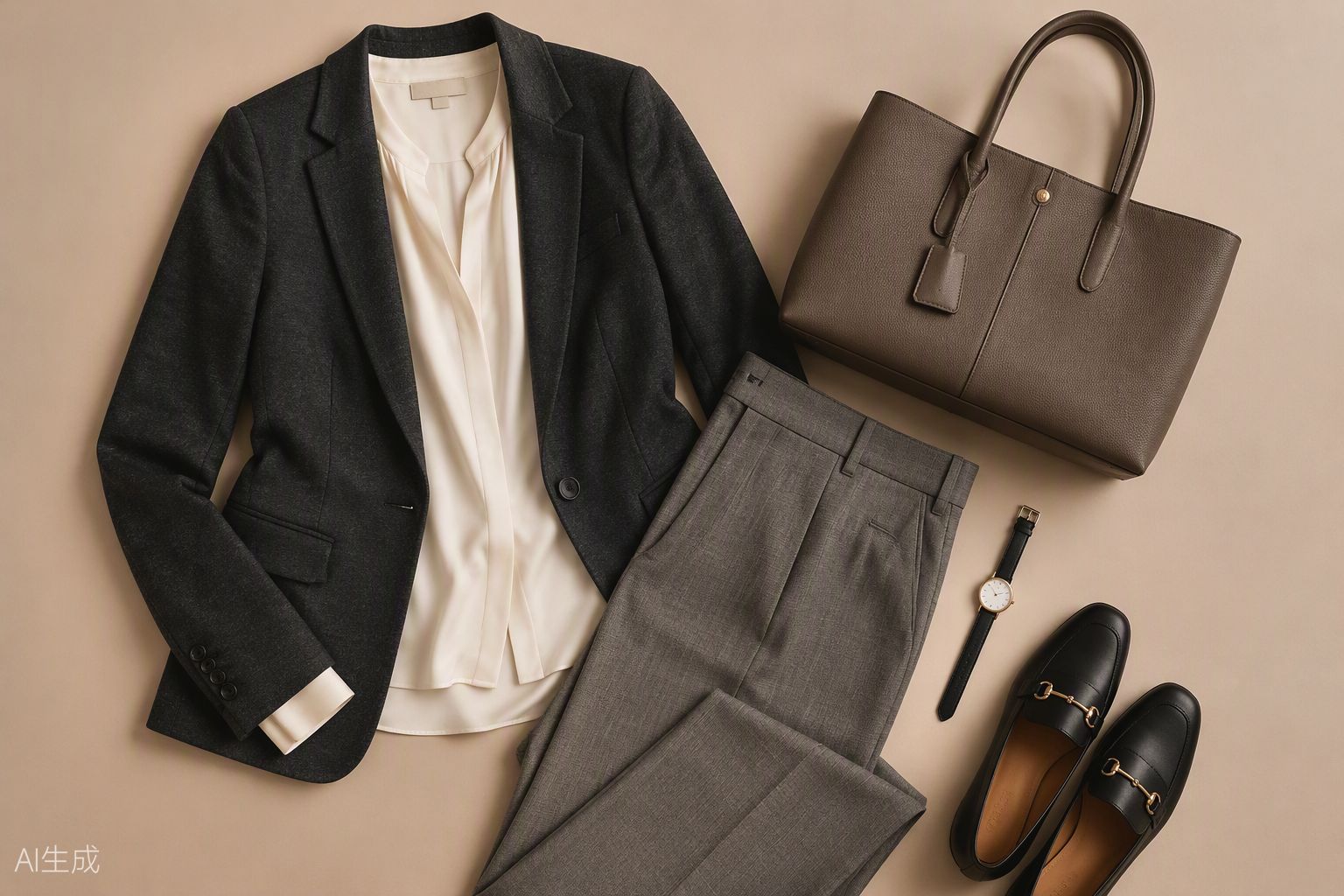
A blazer is the highest-leverage item in the list because it's appropriate almost everywhere — the office, a wedding, a coffee run. Fit is the whole game. Relaxed but still trim gives you layering room without the borrowed-from-someone-else look, and a single-breasted cut is the more flexible choice because it works open or closed. Neutrals pair with everything already in the list.
For knitwear, a fine-gauge cashmere or merino crewneck does more than a chunky sweater: it goes under the blazer, over a shirt, with jeans at work and with a skirt at dinner. Then outerwear appropriate to your actual weather — a trench for mild and wet, a wool coat for cold, a leather bomber if you want the newer, slightly sharper option.
Shoes and Bags
Dress from the bottom up: pick the shoes, then build the outfit. Three pairs covers most lives — a clean white or neutral sneaker, a loafer or ballet flat, and a boot with a block heel. Add a kitten heel pump if your calendar includes evenings out.
One structured tote in a mid-tone leather or suede handles work and travel; one small bag handles everything else. Logo-free shapes age better and don't date your outfit.
- Neutral sneaker that's genuinely clean, not technically clean
- Loafer or ballet flat for polish without a heel
- Block-heel or flat ankle boot
- One structured tote, one small crossbody or clutch
The Minimalist Jewelry Edit
Small earrings are the most underrated essential on this list — a button, a slim hoop, something you can wear to the school run and to a party without changing. They finish an outfit of plain pieces faster than any accessory, and because they're the same every day, they start to read as signature rather than afterthought.
How Many of Each Do You Need? The Laundry-Cycle Rule
Here's the framework I'd use, and it's not one you'll find in most essentials guides: match your quantities to your laundry frequency, not to a magic number of pieces.
If you do laundry weekly, you need roughly eight to nine days of wearable tops in rotation — seven for the week, plus a buffer for the day something spills. If you do laundry twice a week, five is plenty. Hard-wearing pieces that get washed every wear (tees, shirts) need multiples; pieces that get worn over things and washed rarely (blazers, coats, trousers) need almost none. This is why the standard advice to "buy three of your perfect white tee" is right for some people and wasteful for others.
The second half of the rule is a usage audit, and it takes ten minutes. Scroll back through the last fortnight of photos of yourself. Anything that appears twice or more is an essential, whether or not it's on anyone's list. Anything you believed was a staple and can't find once is a piece you like the idea of. That gap — between the wardrobe you think you have and the one your camera roll proves you wear — is where most overbuying happens.
- Wash-every-wear pieces (tees, shirts, base layers): one per day between laundry loads, plus one
- Wash-occasionally pieces (jeans, trousers, skirts): two to three total per category
- Rarely-washed pieces (blazers, knitwear, coats): one excellent one beats three mediocre ones
- Shoes: three pairs in constant rotation, a fourth for evenings
Where to Invest and Where to Save
Spend where construction is visible and wear is heaviest: outerwear, the blazer, the bag, the shoes you walk in. Save where fit matters more than fabric pedigree, or where trend turnover is quick — the striped shirt dress, the seasonal knit, the second pair of jeans.
| Product | Price | Rating | Best for | |
|---|---|---|---|---|
| Quince Quince Cashmere Crew | See retailer | — | See guide | View |
| J.Crew J.Crew Relaxed Blazer | See retailer | — | See guide | View |
| Madewell Madewell Essential Bucket Tote | See retailer | — | See guide | View |
| Quince Quince Italian Suede Shopper Tote | See retailer | — | See guide | View |
| Zara Zara Striped Midi Shirt Dress | See retailer | — | See guide | View |
Check the retailer page for current prices and customer reviews.
One caveat on the invest column: a well-made piece in the wrong silhouette is still the wrong piece. Fit outranks fabric every time, and no amount of cashmere content rescues a sweater that sits oddly on your shoulders.
How to Choose Essentials for Your Actual Life
The reason generic essentials lists fail isn't that the items are wrong — it's that the ratios are. A list built for a five-day office commute doesn't work for someone at home with small children, and vice versa. The fix is to allocate before you shop.
Write down how your week genuinely splits: workdays, caregiving days, errands, exercise, evenings out. Then give each category its share of your essentials budget. If four days a week are casual, four of your seven top slots should be casual, no matter how much you enjoy a silk blouse. If your week is office-heavy, the work capsule wardrobe approach and a clear sense of business casual dressing will serve you better than a general staples list.
- Map your week in days, then match your wardrobe ratios to it
- Choose two or three neutrals that all work together, and add color through tops and accessories
- Buy for the climate you live in, not the one in the lookbook
- Replace before you expand — a worn-out staple costs you more outfits than a missing trend piece
Fabric and Fit: What to Check Before You Buy
Quality assessment doesn't require expertise, just a few seconds of attention in the fitting room.
- Hold it up to light: if a white tee or shirt is see-through now, it will be worse after washing
- Stretch the seam gently — if you can see the stitching gap, it will split
- Check the shoulder seam sits where your shoulder ends, on blazers especially; it's the hardest thing to alter
- Pull the knit and let go: good yarn springs back, cheap yarn stays stretched
- Sit down in trousers and skirts before deciding, and raise both arms in a blazer
- Read the care label honestly — a dry-clean-only everyday piece will quietly stop being everyday
Five Mistakes That Make an Essentials Wardrobe Feel Boring
- Buying all neutrals and nothing with texture — a wardrobe of flat cotton in beige reads cheap even when it isn't
- Owning one of each category and no duplicates of the pieces you wear constantly
- Treating the dressier piece as off-limits for daytime; the long skirt is a Tuesday item, not a special-occasion item
- Mixing silhouette eras — low-rise trousers and cropped tops don't layer with high-rise jeans and long shirts
- Keeping the worn-out version alongside the replacement, so you keep grabbing the wrong one
The texture point deserves a little more space. Interest in a minimal wardrobe comes from material contrast, not pattern: suede against denim, fine knit under crisp cotton, matte leather with something with sheen. That's how an outfit of five plain items reads as considered rather than unfinished.
How to Make Ten Pieces Feel Like Thirty Outfits
This is the premise behind the small-capsule approach that stylists at Everyday Style teach: a tightly chosen group of ten pieces can produce more than thirty outfits, because every top works with every bottom and every layer goes over all of it. The math works only if you enforce the compatibility rule when you buy, which is why the single most useful question in a fitting room is "what three things in my closet does this go with?"
Then build variety through styling rather than volume. Tuck the tee fully, half-tuck it, or leave it out. Wear the button-down closed, open over the tee, or knotted. Put the blazer over the dress. Swap the sneakers for loafers and the same outfit moves from weekend to meeting. Those are five decisions, not five purchases.
Seasonal updating works the same way: keep the core twelve stable and rotate two or three pieces to keep things current. If you want the newer shapes without rebuilding anything, the 2026 trend report is where to pick your two.
Care, Repair, and the Annual Edit
Essentials earn their status by lasting, which means care is part of the strategy. Wash knitwear cold and lay flat, air denim between wears, de-pill sweaters twice a season, and resole good shoes before the damage reaches the upper. Keep a small repair pile and clear it monthly rather than letting it become a graveyard.
Once a year, pull everything out and sort into three piles: wearing, repairing, and finished. The finished pile tells you your shopping list — and it's usually shorter and more boring than the one you'd have written from scratch. That's the sign it's correct.
A good essentials wardrobe isn't an achievement you finish. It's a rotation you maintain, and the reward is the smallest, most underrated luxury in fashion: getting dressed without thinking about it.
Common questions
Frequently Asked Questions
Sources
Written by
Emma Carter
Editor-in-Chief
Emma spent a decade styling editorial shoots in New York and London before founding Pearlthread. She believes great style is a system, not a shopping habit — and that the best outfit is the one you don't have to think about.
- ✓ 10+ years in fashion editorial (NY & London)
- ✓ Certified image consultant, AICI
- ✓ Personally road-tests every reviewed product for 2+ weeks
Enjoying this guide?
Get the next one in your inbox on Sunday.
Newsletter sign-ups are not available yet.
Keep reading
Related guides
Capsule · Shopping Guide
The Ultimate Capsule Wardrobe Checklist for Every Season
Everything you need to build a capsule wardrobe checklist that fits your real life, from the 3-3-3 rule to a full seasonal shopping list.
7 min read
Capsule · Trend Report
The Complete Guide to Building Your Capsule Wardrobe Color Palette
A well-chosen color palette is the secret to a capsule wardrobe that actually works. Here's how to select colors that complement each other, flatter your skin tone, and multiply your outfit options.
12 min read
Capsule · Trend Report
How to Build a Work Capsule Wardrobe That Actually Works
Building a work capsule wardrobe transforms your morning routine and sharpens your professional presence. Here's how to curate versatile pieces that work together seamlessly.
11 min read
Workwear · Shopping Guide
Business Casual for Women: The Complete 2026 Guide
Business casual is the dress code nobody defines and everybody enforces. Here's the actual rulebook for 2026 — plus the 12 pieces that cover every office.
10 min read