Staple Pieces for Women: The 14 Basics That Actually Earn Their Keep
A staple is not just a basic in a neutral color. It is a piece that fits your week, your body and the clothes already hanging next to it. Here is how to choose yours.
Affiliate disclosure: this article contains affiliate links. If you buy through them, we may earn a commission at no extra cost to you — it funds our testing. Learn more.
Every wardrobe list promises the same payoff: buy these items, and getting dressed stops being a decision. The lists are not wrong. They are just incomplete. A white tee and a pair of straight-leg jeans will serve almost anyone, but the version that works for a teacher who hikes on weekends is not the version that works for someone in meetings four days a week. The pieces are universal. The specification is personal.
So this guide does two things. It gives you the core list, because a list is a useful starting point. Then it gives you the criteria underneath the list, so you can tell a staple from a nice-looking item that will hang unworn. That second part is what actually fixes a wardrobe.
What Makes Something a Staple Piece for Women?
A staple is a piece you reach for without thinking, in a cut and color that cooperates with most of your closet. Stylist Erica, who covers this in her breakdown of how different women style five capsule staples, points to the same short set of traits: solid neutral colors that mix and match, streamlined silhouettes, good construction and fabric that holds its shape after washing. The test she uses is flexibility. Can you wear it down for daytime and up for evening? If yes, it is pulling real weight.
The flip side matters just as much. A piece can be beautifully made, classic in theory, and still not be a staple for you. A draped vest, a pencil skirt, a silk slip dress: all legitimate wardrobe items, none of them automatically essential. Essential is defined by frequency, not by heritage.
- It survives laundry. Shape, color and hem all look the same on wear ten as on wear one.
- It works in at least three outfits you would actually leave the house in.
- The color sits inside your existing palette rather than asking you to build around it.
- The silhouette is simple enough that accessories, not the garment, carry the personality.
- It is comfortable enough to wear for a full day without adjusting it.
- It fits now, at your current size and your current life, not at a hypothetical one.
Here is a filter I have not seen on the standard checklists, and the one I would apply before buying anything: the neighbor test. Pull the two garments hanging on either side of where the new piece would live. If it does not make an outfit with either of them, it is not a staple in your closet. It is a soloist. Soloists are fine, but you want a handful of them, not a rack.
The 14 Staple Pieces for Women Worth Owning
Grouped by job rather than by category, because that is how outfits get built. You do not need all fourteen at once, and some of them you may never need. Treat this as a menu.
Tops That Do the Most Work
The white tee is the piece people most often get wrong, because they buy it as an afterthought. A staple tee is cut in a cotton heavy enough to hold its line, and the neckline and length suit your proportions rather than the mannequin's. There are three broad shapes worth knowing: boxy and slightly cropped, which sits well over wide-leg trousers; fitted crew, which layers cleanly under a blazer; and fitted V-neck, which gives a little vertical space if you prefer it. If you fall between sizes in a boxy cut, size up.
The crisp button-up is the second workhorse. White cotton is the most useful version, and a lightweight poplin reads sharper than a thick oxford under layers. A silk or silk-blend shirt in ivory or black does the evening version of the same job. The third top is the one that gets left off most lists and shouldn't: a fine-knit black turtleneck. A reader on 40+Style made this exact case, and it holds up. It works with every pair of trousers including white, it layers under blazers and coats, and it carries three seasons on its own.
- White cotton tee in your best neckline and length
- White cotton button-up, lightweight weave
- Fine-knit black turtleneck, cashmere or merino if the budget allows
- One neutral crewneck sweater in a mid-weight knit
Bottoms You Can Build On
Denim is where fit beats brand by a wide margin. Two pairs cover most needs: a high-rise straight leg for everyday, and either a wide leg or a mid-rise straight depending on whether you want the volume. A dark, clean wash dresses up; a mid-blue reads more casual. Then tailored trousers, which are the bread-and-butter piece that most wardrobes are short on. High-waisted or straight-cut, in a fabric with enough weight to hang rather than cling, they take you from denim-free workdays to dinner with a change of shoe.
If your week is mostly casual, a third bottom in the same family is more useful than adding a dressier one. If your week is mostly professional, invest here before you invest anywhere else. For a deeper breakdown of the professional version, see our guide to business casual for women.
- High-rise straight-leg jeans in a dark or mid wash
- Second denim shape: wide leg or mid-rise straight
- Tailored trousers in black, navy or a true neutral
- One easy casual bottom, whether that is a well-cut chino, a knit trouser or a denim skirt
Layers That Set the Tone
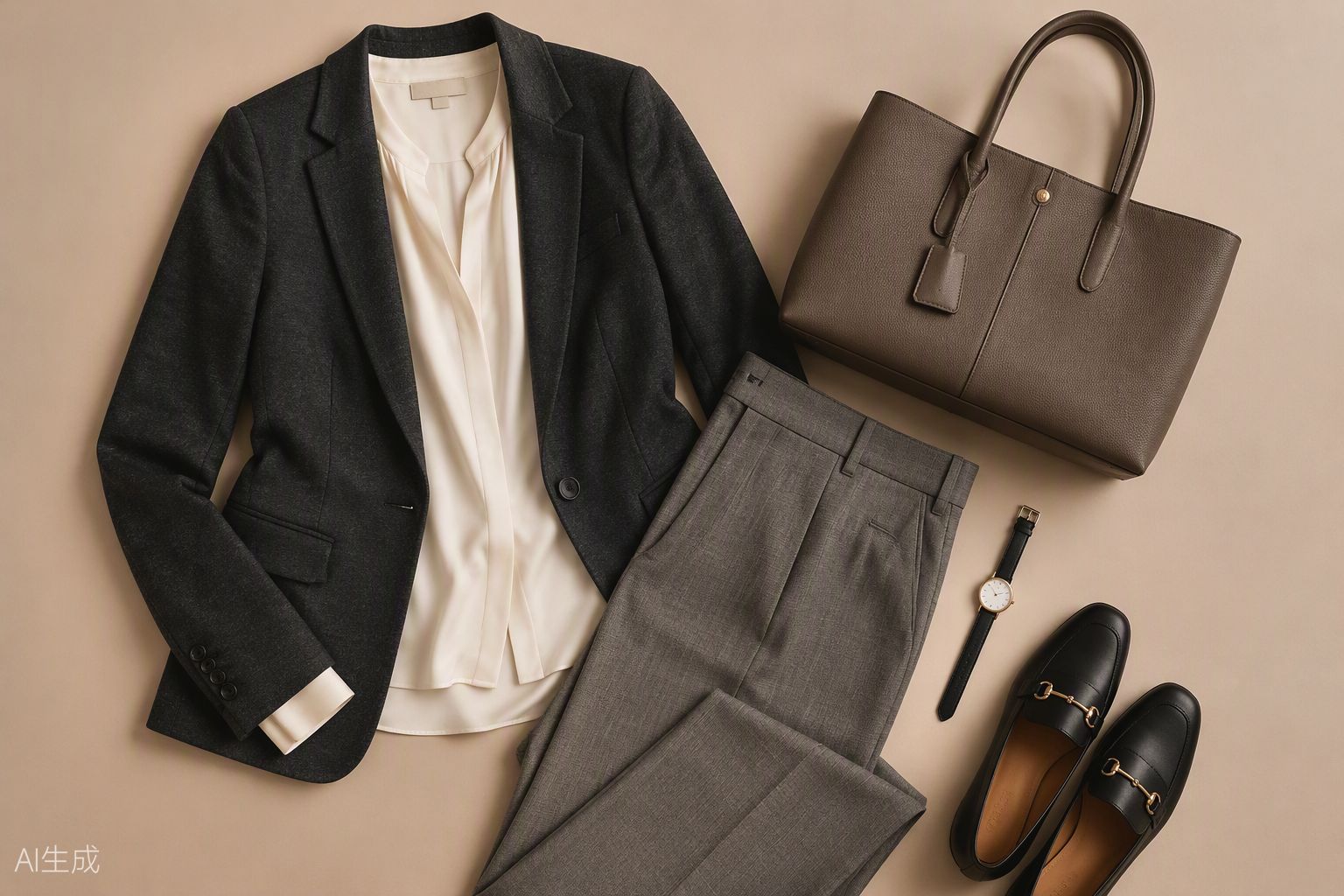
A tailored blazer changes the register of everything underneath it. One styling note worth taking seriously: if you buy a suit, you need to like the jacket and the trousers independently, because a blazer that only works with its matching pants has halved its own value. Button placement matters more than people expect. A single-button jacket reads long and lean; a three-button or wrapped front gives more coverage across the chest and tends to suit taller or fuller figures better. The other two layers are a classic trench, which handles shoulder-season weather and looks deliberate over everything, and a good wool coat for actual cold.
Dresses and Skirts
The little black dress still earns its reputation, as long as you buy the one you would actually wear to the events on your calendar rather than the one from the reference photo. A simple midi skirt is arguably more useful week to week: silk or a fluid fabric for evening, something sturdier for daytime, and both of them work over knee-high boots. And a white or ivory midi dress covers spring and summer in one item, which is a reasonable use of a hanger. Skip any of these if the occasion does not exist in your life.
Shoes, Bags and the Small Stuff
Three pairs of shoes carry most wardrobes: clean white sneakers, a flat or low ankle boot, and one dressier option that you can stand in for two hours. White sneakers need maintenance to stay staples rather than scuffs, so a stain protector is a small, sensible purchase. Then one structured bag in a neutral leather, a pair of sunglasses in a frame that suits your face, and a good leather belt. Belts are underrated: cinching a piece you had written off as shapeless is often all it takes to bring it back into rotation.
The Five-Piece Foundation to Start With
White · See guide
White Cotton Crewneck Tee
See the full write-up in this guide.
check live price
High-Rise · See guide
High-Rise Straight-Leg Jeans
See the full write-up in this guide.
check live price
Lightweight · See guide
Lightweight White Poplin Button-Up
See the full write-up in this guide.
check live price
Fine-Knit · See guide
Fine-Knit Black Turtleneck
See the full write-up in this guide.
check live price
Single-Button · See guide
Single-Button Tailored Blazer
See the full write-up in this guide.
check live price
Fabric: The Quiet Difference Between a Staple and a Stopgap
Two tees can look identical on the rack and behave completely differently after a month. The difference is fiber content, weight and finish. Thin cotton with a high elastane percentage tends to go soft and wavy at the hem. Heavier cotton, especially a compact knit, keeps its line. Wool and wool blends drape on the body instead of standing away from it, which is why tailored trousers in a wool blend flatter more reliably than the same cut in a stiff synthetic.
- Tees and tanks: mid-to-heavyweight cotton; treat anything sheer under bright light as a layering piece, not a standalone.
- Shirts: cotton poplin for structure, silk or silk blend for softness and evening.
- Knits: merino and cashmere for warmth without bulk; check for tightly spun yarn, which pills less.
- Trousers and blazers: wool or wool blends for drape; a touch of stretch for comfort, not a lot.
- Denim: rigid or low-stretch holds its shape through the day; high-stretch is comfortable but bags out faster.
One practical habit: read the care label before the brand label. A staple you cannot wash at home, or will not hand wash in practice, quietly stops being a staple around week three. If dry cleaning genuinely does not fit your life, that is useful information and it should shape what you buy.
Fit Comes Before Brand, Every Time
The most common reason a classic piece feels wrong is not the piece. It is two centimeters at the shoulder or five at the hem. Shoulders are the one measurement that is expensive to correct, so fit a blazer or coat to your shoulders first and have the rest adjusted. Sleeve length, hem length and waist suppression are all straightforward alterations, and the cost of a hem is usually a fraction of what it adds in wearability.
It also helps to know your own proportions rather than chasing a trend silhouette. If your torso is long, a high-rise trouser gives you back the balance. If your legs are long, a mid-rise and a cropped top can look more proportionate than a high-rise does. None of that is a rule about what you are allowed to wear; it is just information about where the eye lands.
- Fit to your shoulders and your widest point, then alter down.
- Hem trousers to the shoe you will wear with them most, not to your tallest heel.
- Check sitting, reaching and walking in the fitting room, not just standing still.
- If a garment needs shapewear or a specific bra to work, build that into the decision.
Straight, Wide or Something Else: A Quick Decision Guide
Most people stall on denim and trouser shape, so here is a side-by-side way to think about it. Match the column to the week you actually have, not the week you admire on Instagram.
| Product | Price | Rating | Best for | |
|---|---|---|---|---|
| High-Rise High-Rise Straight-Leg Jean | See retailer | — | See guide | View |
| High-Rise High-Rise Wide-Leg Jean | See retailer | — | See guide | View |
| Tailored Tailored Wool-Blend Trouser | See retailer | — | See guide | View |
Check the retailer page for current prices and customer reviews.
Build Around Your Real Week, Not an Imaginary One
This is where most checklists fall over. A 40+Style reader put it plainly in the comments of their wardrobe essentials checklist: she works in special education, hikes and works out on weekends, and wears a skirt only when it is very hot. Half the standard essentials list is irrelevant to her, and she is right about that. A midi skirt and a silk blouse are not staples in that life. A durable knit, a good trouser and a jacket that survives a playground are.
Try this before you shop. Write down the last fourteen days and label each day with the kind of outfit it needed: casual-active, casual-polished, work, or evening. Count the labels. That ratio is your buying ratio. If eleven of fourteen days were casual-active, your budget belongs in excellent casual pieces, and one dressy option is plenty. It sounds obvious written down. Almost nobody does it, which is why so many closets hold three blazers and no good everyday trouser.
- Mostly casual-active: prioritize durable knits, two denim shapes, sneakers and a weatherproof layer.
- Mostly work or client-facing: prioritize two tailored trousers, a blazer that works alone, and shirts in cotton and silk.
- Split evenly: buy pieces that cross over, such as a dark straight-leg jean, a fine knit and a low ankle boot.
- Frequent evenings out: the LBD and a fluid midi skirt move up the list; the chino moves down.
If you want help translating that into a palette that mixes without effort, our capsule wardrobe color palette guide walks through choosing your neutrals and your two accent colors. Worth noting: your neutral is not automatically beige or navy. It is whichever color already appears most often in your closet, because that is the one you reach for.
Staple Pieces for Women Over 40
The list does not change much with age. What changes is the emphasis. Fabric quality matters more, because thin and clingy reads less polished on everyone and is less comfortable besides. Coverage options matter more: a three-quarter sleeve, a slightly higher neckline, a knit with enough body to skim. And silhouette balance becomes the lever worth pulling, which is why the rule of thirds keeps coming up in this conversation. Breaking your outfit at roughly one-third rather than halfway tends to read longer and more deliberate.
Two specific swaps are worth making. First, upgrade the black turtleneck to cashmere or fine merino if you can, since it is the piece that will do the most days of work. Second, use a belt as a shaping tool rather than a decoration. Pieces pushed to the back of the closet for feeling shapeless often come back to life with a medium-width leather belt at the waist. And be skeptical of any silhouette that adds bulk right at the hip if that is not where you want volume, regardless of how it looked on the model.
Where to Spend and Where to Save
Spend where construction is doing structural work and where you will wear the piece most. Blazers, coats, trousers, leather goods and knitwear reward a higher budget with better drape, better seams and a longer life. Save on pieces that are either trend-adjacent or genuinely well made at lower price points. A good cotton tee does not require a designer label. Neither does a denim skirt or a plain tank. The one caveat is that cheap knitwear tends to pill fast, so a mid-tier sweater often outlasts two budget ones.
- Spend: blazer, wool coat, trench, tailored trousers, leather boots, one structured bag.
- Mid-range: denim, merino and cashmere knits, silk-blend shirts.
- Save: cotton tees and tanks, basic cotton button-ups, casual skirts, seasonal accessories.
- Maintenance budget: shoe protector, a sweater comb, a tailor you trust.
A 90-Day Plan to Build Your Staples
Buying everything at once is how you end up with a closet full of items that nearly work. Staggering it lets each purchase prove itself before the next one arrives.
- Weeks 1–2: audit what you own. Photograph every outfit you actually wear and note the gaps. Our capsule wardrobe checklist gives you the framework.
- Weeks 3–4: buy or fix your two best bottoms. Hem them. Everything else hangs off this decision.
- Weeks 5–6: add the tops that pair with those bottoms. Tee, button-up, turtleneck.
- Weeks 7–8: one layer that elevates the whole set, usually the blazer. Get the sleeves altered.
- Weeks 9–10: shoes. Buy for the surfaces and distances you actually cover.
- Weeks 11–12: the one occasion piece your calendar genuinely requires, plus the belt and bag that tie the set together.
Five Mistakes That Keep Wardrobes Feeling Incomplete
- Buying for the lifestyle in the photo rather than the one in your calendar.
- Treating neutral as a color you have to adopt instead of the one you already wear most.
- Skipping alterations, then blaming the garment.
- Buying the dressy version of everything and nothing for Tuesday.
- Replacing a staple with a near-identical new one while the original sits unworn because the hem is wrong.
If you only fix one thing this season, fix your everyday trouser. It is the piece that quietly decides how the rest of your week looks.
Check Price — Tailored Tailored Wool-Blend Straight TrouserWe may earn a commission at no cost to you.
The point of staple pieces for women is not minimalism for its own sake. It is removing friction. When the foundation fits, the fun part gets easier: the one bright coat, the printed scarf, the shoes that are slightly too much. If you want to see what is worth adding on top this year, our take on fall fashion trends 2026 covers the pieces that play well with a neutral base, and the work capsule wardrobe handles the professional half of the equation in more detail.
Common questions
Frequently Asked Questions
Sources
Written by
Emma Carter
Editor-in-Chief
Emma spent a decade styling editorial shoots in New York and London before founding Pearlthread. She believes great style is a system, not a shopping habit — and that the best outfit is the one you don't have to think about.
- ✓ 10+ years in fashion editorial (NY & London)
- ✓ Certified image consultant, AICI
- ✓ Personally road-tests every reviewed product for 2+ weeks
Enjoying this guide?
Get the next one in your inbox on Sunday.
Newsletter sign-ups are not available yet.
Keep reading
Related guides
Capsule · Trend Report
The Complete Guide to Building Your Capsule Wardrobe Color Palette
A well-chosen color palette is the secret to a capsule wardrobe that actually works. Here's how to select colors that complement each other, flatter your skin tone, and multiply your outfit options.
12 min read
Capsule · Shopping Guide
The Ultimate Capsule Wardrobe Checklist for Every Season
Everything you need to build a capsule wardrobe checklist that fits your real life, from the 3-3-3 rule to a full seasonal shopping list.
7 min read
Capsule · Trend Report
How to Build a Work Capsule Wardrobe That Actually Works
Building a work capsule wardrobe transforms your morning routine and sharpens your professional presence. Here's how to curate versatile pieces that work together seamlessly.
11 min read
Workwear · Shopping Guide
Business Casual for Women: The Complete 2026 Guide
Business casual is the dress code nobody defines and everybody enforces. Here's the actual rulebook for 2026 — plus the 12 pieces that cover every office.
10 min read